 BoardFoot
Board Foot Calculator: The Ultimate Guide to Calculating Lumber Volume & Costs
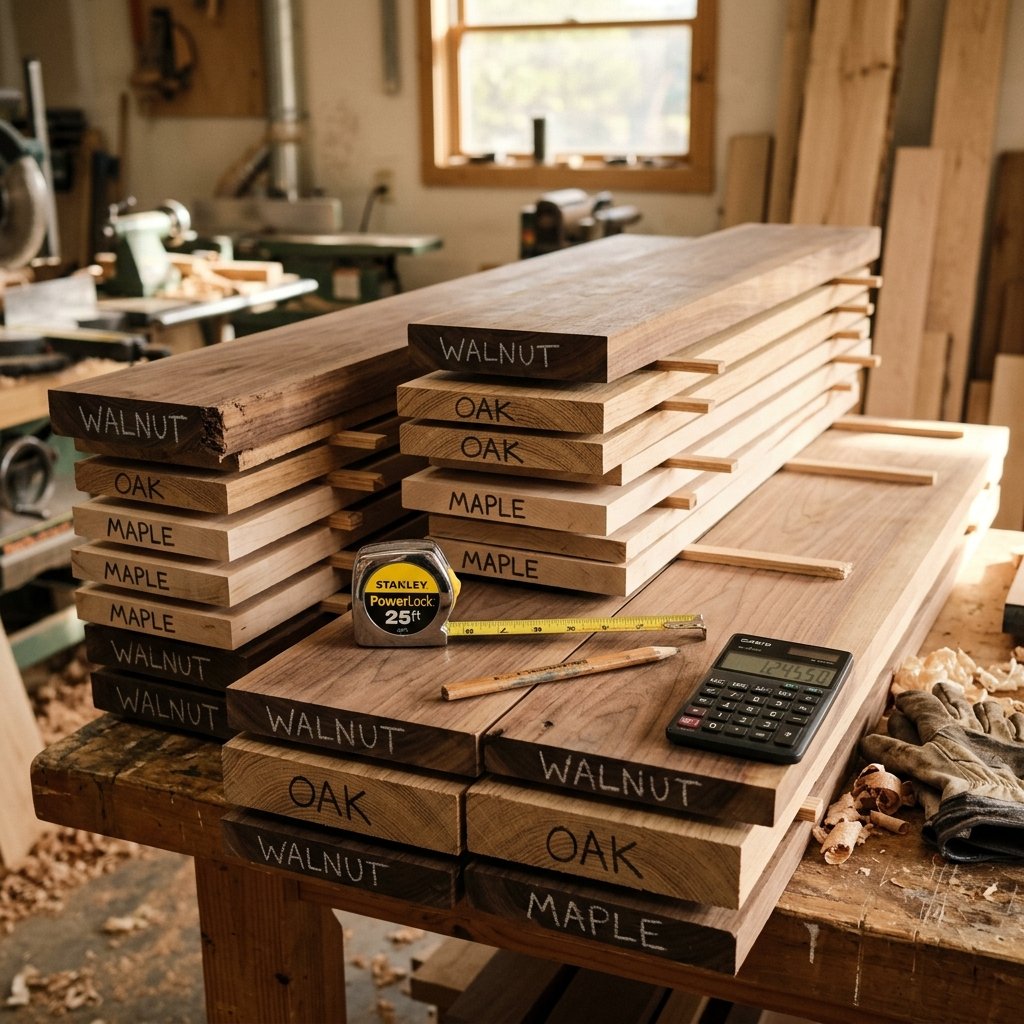
Buying lumber is one of the most exciting—and potentially most confusing—parts of any woodworking project. Whether you're standing in a massive commercial lumberyard in the Pacific Northwest or a small local sawmill in Georgia, you'll encounter a unit of measurement that doesn't exist at the local fabric shop or flooring center: the board foot (BF).
Understanding how a board foot calculator works is the difference between coming home with exactly what you need and overpaying for wood you'll never use. In this comprehensive guide, we'll break down the lumber calculator formulas, explain how to convert linear feet to board feet, and help you master the price calculator logic used by professionals.
Table of Contents
- 1. What is a Board Foot? (The Definition)
- 2. How to Use a Board Foot Calculator
- 3. The Universal Board Foot Formula
- 4. Converting Linear Feet to Board Feet
- 5. Square Feet to Board Feet Conversion
- 6. Calculating Cost Per Board Foot
- 7. Log Board Foot Calculator (Doyle & Scribner)
- 8. Managing Waste Factors and Industry Standards
What is a Board Foot?
A board foot (BF or FBM) is a unit of volume specifically used for lumber in the United States and Canada. Unlike a square foot (which measures surface area) or a linear foot (which measures length), a board foot accounts for all three dimensions of a piece of wood: thickness, width, and length.
A board foot is a measurement of wood volume equivalent to a board that is 12 inches wide, 12 inches long, and 1 inch thick (144 cubic inches). In the lumber industry, this is the standard unit of measurement used for billing and inventory management, ensuring pricing remains consistent regardless of a board's individual dimensions.
It is important to note that the industry uses nominal dimensions for calculations. This means that a 2x4 (which is actually 1.5" x 3.5") is still calculated using its nominal name (2x4) when determining board footage for billing purposes in most commercial settings.
How to Use a Board Foot Calculator
Using an online board foot calculator is the fastest way to get accurate results for your project. To get the most out of our tool, follow these simple steps:
- Enter Thickness: Input the thickness in inches. For standard lumber, use 1 for 4/4 wood, 1.5 for 6/4, or 2 for 8/4.
- Input Width: Measure the width of your board in inches. If you have several boards of the same width, you can sum their widths or calculate them individually.
- Set the Length: Enter the length in feet. Our lumber calculator is designed for the standard US foot measurement.
- Select Waste Factor: Most professionals add 15-20% to account for knots, cracks, and offcuts.
Ready to simplify your project?
Use our professional-grade tool to get instant results.
Calculate Board Feet NowThe Universal Board Foot Formula
If you're out in the field without access to a digital lumber calculator, you'll need the industry-standard formula. This formula works for any piece of dimensional lumber:
Board Feet = (T" × W" × L') / 12
Example Calculation:
If you have an 8-foot long oak board that is 6 inches wide and 1 inch thick (4/4):
(1" × 6" × 8') = 48
48 / 12 = 4 Board Feet
Converting Linear Feet to Board Feet
Often, you'll know exactly how many 8-foot or 10-foot boards you need, but the lumberyard wants the total in board feet. This is where linear to board foot conversion becomes vital.
To convert linear feet, you must know the width and thickness of the material. A common mistake is assuming linear feet and board feet are identical. They only match when a board is exactly 12 inches wide and 1 inch thick. For a 2x4, every 1.5 linear feet equals 1 board foot.
Our price calculator internally handles these conversions, allowing you to focus on the total cost rather than complex math. For more on this, check out our guide on how to calculate board feet manually.
Estimate Your Materials Instantly
Stop guessing the volume for your woodworking projects.
Calculate Board Feet NowSquare Feet to Board Feet Conversion
If you're planning a project like a deck or a tabletop, you might start with the total surface area (square feet). Converting square to board foot depends entirely on the thickness of the wood.
- If the wood is 1 inch thick (4/4): 1 Square Foot = 1 Board Foot.
- If the wood is 2 inches thick (8/4): 1 Square Foot = 2 Board Feet.
- If the wood is 0.5 inches thick (thin stock): 1 Square Foot = 0.5 Board Feet (though many yards bill 4/4 as a minimum).
Because thickness is often ignored in general construction quotes, understanding this conversion is essential for accurate budgeting. You can read a deeper comparison in our board foot vs square foot article.
Calculating Cost Per Board Foot
Knowing the board footage is only half the battle; knowing the cost per board foot is what keeps your project on budget. Lumber prices fluctuate based on species durability, grain patterns, and regional availability.
To calculate the total cost of a board, use the primary formula:
Total Cost = Board Feet × Price Per Board Foot
For example, if walnut is priced at $12.50 per board foot and you need 15 board feet, your total would be $187.50. High-end hardwood dealers often use a tiered price calculator system where "Selected" or "FAS" (First and Seconds) grades cost significantly more than "Common" grades. For current market rates, see our 2026 Lumber Pricing Guide.
Get Accurate Pricing Estimates
Plan your budget with confidence using our tool.
Calculate Board Feet NowLog Board Foot Calculator (Doyle, Scribner, International)
If you're a sawmill owner or buying standing timber, you aren't dealing with square boards yet. This is where a log board foot calculator comes in. Log scales estimate the amount of usable lumber that can be sawn from a specific log diameter and length.
There are three major log scales used in North America:
- Doyle Log Scale: Common in the Eastern US. It tends to underestimate smaller logs, which benefits the buyer.
- Scribner Decimal C Scale: Popular in the West and with the Forest Service. It uses diagrams of expected boards to estimate volume.
- International 1/4 Inch Scale: The most accurate scale, accounting for the saw kerf (the wood lost to the blade).
Calculating the potential yield of a standing tree or a raw log requires accounting for the bark and the "taper" of the log. If you are milling your own lumber, always use a specialized log calculator to ensure you are getting a fair yield from your timber.
Managing Waste Factors and Industry Standards
The biggest mistake beginners make when using a lumber calculator is failing to account for "waste." wood is a biological product. It moves, checks, and contains natural defects that must be removed during the building process.
Industry standards for waste include:
- 10-15%: For high-grade hardwoods (FAS) with minimal knots.
- 20-25%: For lower grades or projects requiring highly specific grain matches.
- 30%+: When working with reclaimed wood or logs with significant rot or insect damage.
By including a waste factor in your initial board foot calculator input, you protect yourself from material shortages that can stall a project and lead to mismatched wood colors from different batches.
Don't Run Out of Wood Mid-Project
Calculate your needs including waste factors now.
Calculate Board Feet NowConclusion: Mastering Lumber Measurement
The board foot calculator is more than just a convenience tool; it's a fundamental part of the woodworking craft. By mastering the lumber calculator formulas for linear to board foot and cost per board foot, you empower yourself to make better buying decisions and more accurate project quotes.
At BoardFootCalcs, we are dedicated to providing the most accurate, professional-grade tools for the global woodworking community. Whether you're building a simple birdhouse or a bespoke dining table, start your project with the right numbers.
About the Author
Our team consists of veteran woodworkers and construction specialists with over 50 years of combined experience in the US lumber industry. We believe that professional tools should be free, accessible, and easy to use for everyone.